Wednesday, January 12, 2022

2022 Preseason Diary: Where We Stand on December 1st

My primary objective this winter was to get rid of Jose Altuve's salary, which we did before the '21 season ended. Doing so gives us roughly $20 million to spend this winter, with four major holes on our roster:

Hole #1: Starting Pitching

This past year, we tried the strategy of building a world-class starting rotation filled with all-stars and Cy Young candidates. Needless to say, that strategy failed miserably. I can't help but notice the success of teams like the Great Lakes Sphinx, who consistently win 90+ games per year despite having mediocre -- at best -- rotations. The key is having a great bullpen. You could make a great argument that our bullpen won the 2019 championship for us. I'd like to get back to that place in '22.

Rather than throw a bunch of money at ace starting pitching this winter, I think that we will fill our 360-inning void with two serviceable inning-eaters instead. After his recent signing with the St. Louis Cardinals (who seem to have the Midas touch with pitchers), we feel that Steven Matz would be a perfect fit this winter. I don't think he will be expensive to acquire, but I've been very wrong about that before.

Hole #2: First Base

There are several free agent options to fill this hole, which would solve our 2022 problem nicely. The problem is that all of those options involve future risk on aging veterans pushing age forty. Joey Votto (age 37, .266/.375/.563) would be a tremendous asset against right-handers, but he would be an extremely expensive platoon player. He would likely cost around $7 million to sign, which means a guaranteed $15 million in 2023 and 2024. No, thanks.

Yuli Gurriel (age 38, .319/.383/.462) would also solve our problem this year, and doesn't have the platoon issues that Votto has. But again, he would cost around $6-$7 million, and has a very inconsistent track record.

C.J. Cron (age 29, .281/.375/.530) is practically a kid compared to those other two, but he comes with the Coors Field Factor. Deflate those numbers by 20-percent and suddenly he's rather useless. At the other end of the spectrum is Brandon Belt (age 33, .274/.378/.597), who plays in a drastic pitcher's park in MLB, and would be a perfect fit for us...but he had only 381 PA's.

Those are the only real free agent options, although some semi-useful platoon players like Ji-Man Choi will be available in the draft. As far as trading goes, we reached out to the new Allentown owner to see if he would be willing to move Matt Olson. He shot down that idea before even hearing an offer.

Chicago has placed Anthony Rizzo on the Selling block, but he is far too expensive for a platoon player, and comes with ballpark-factor baggage as well. We briefly spoke to Chicago about Tyler Stephenson, but those talks ended abruptly. Likewise, we made inquiries to Kansas about Max Muncy, but as usual, the asking price was far too steep.

South Loop would seem to be the ideal trading partner, as they own both Freddie Freeman and Jose Abreu. Unfortunately, their owner is impossible to deal with.

Where does that leave us? Probably Band-Aid mode. A patch here, a patch there, and we'll somehow patch together a first baseman when all is said and done.

Hole #3: Catcher

It really would be nice if the Baltimore Orioles would stop dicking around and just promote Adley Rutschman to the big leagues like he deserves. Instead, we have to wait for them to finish playing their little games with his service time. It's absolutely ridiculous that snot-nosed 19-year-old Wander F'ing Franco is mature and experienced enough to get a full-time MLB gig (with a multi-billion-dollar contract), but the 23-year-old Rutschman has to wait yet another year to get his shot.

In any case...Yan Gomes (890/634 splits in only 375 PA's) may be the only catcher in the auction, and I wouldn't want him, anyway. On the trading side, there aren't many palatable options. The catching position this year is a bit of a wasteland, so we're hardly the only team in this position.

We did reach out to Bobby Sylvester of the Highland Freedom to see if he wants to do something crazy by trading Salvador Perez. You never know. It doesn't hurt to ask!

Hole #4: Right Field vs. Right-handers

Regardless of whether Diamond Mind gives Shohei Ohtani a rating in the outfield, we would be insane not to play him there. He will kill us with his defense -- again -- but his bat simply has to be in the lineup. Unfortunately, so does Andrew Benitendi's bat. He isn't great, but we're paying him too much to sit, and we need the warm body to fill that spot against lefties and righties. Ramon Laureano can't hit righties, and is limited in playing time overall, but he can fill the void against lefties.

That leaves one glaring hole for us in the outfield against right-handed pitchers. There are so many decent options in the auction that we are bound to get one for a decent price. The best of the lot is A.J. Pollock (872/902 splits), who is coming off a career year at age 33. In other words, it is the worst time possible to buy A.J. Pollock.

The Budget, As It Stands

A lot can happen from now until January, but if the auction were to begin today, here is a rough outline of what our budget would look like:

Steven Matz: $6M
Brandon Belt: $6M
Starting Pitcher: $3M
RF vs. RH: $3M
Two catchers: $1M
Seven scrubs: $700K

That would be $19.7 million, total, which is under our $20.2 million budget. The problem is that if we execute this budget perfectly, we're left with a team that isn't nearly good enough. We're going to need a little good fortune to fall in our lap over the next four weeks or it will be another long season.

2022 Preseason Diary: The Auction

January 1: 

It's the first day of the auction, and already we are faced with a dilemma. We have $5 million budgeted for a reliever. Our one pressing need is a right-handed reliever who dominates righties, while keeping lefties in check. There are two pitchers in this auction that fit this criteria better than most: Kenley Jansen and Scott Barlow.

Jansen is 34 years old. Las Vegas has the tie-breaker on him. There is no reason on God's green earth for Johnny Bo to pay $5 million for a reliever, given his team's situation, but he has a crazy amount of money to spend. It seems highly-plausible that he goes the max on Jansen before Type H kicks in -- and no one in his right mind would go Type H.

That leaves Barlow, who just happens to be in Lot #1. Cleveland currently owns the high bid at $3.5M, and we're only a few hours into the auction. No one owns the ultimate tie-breaker on Barlow, but the Rocks just barely edged us for the tie-breaker on wins.

Would Mike Stein go all-in on a middle reliever at $5M this early in the auction? If he does, could we get Jansen? If not, what's our backup plan? Already, this auction is stressing me out, and it just began!

January 2:

Barlow's price is now $4.5 million, and is almost certain to reach $5M by tomorrow night when his auction ends. We will pass, and hope that one of the many other relievers falls to us at $5M or below. Meanwhile, I can't help but notice how shitty these lots are arranged. It is hard to imagine a way that they could be ordered more poorly from my perspective.

The first basemen that I want to sign are: Brandon Belt, Yuli Gurriel, and Mark Canha. In that order. Unfortunately, they are available in reverse order in this auction. Canha is in Lot #3, Gurriel in Lot #9, and Belt in Lot #10. This creates a massive dilemma. If we win the bid on Canha, we can move him to the outfield. No big deal. If we win the bid on Gurriel, then we can't possibly bid on Belt -- which would be an absolute shame, as he will be a BEAST this year. If we gamble by waiting for Belt, and our $7 million bid isn't enough, then we're absolutely screwed at the first base position.

We see the same type of dilemma, to a lesser extent, among the starting pitchers. Ranger Suarez is our #1 target, and he appears in Lot #5. We plan to bid $7 million for him, but what if we don't get him? Eduardo Rodriguez would be our second choice, but he's in Lot #2. Sonny Gray would be choice number three, but he's in Lot #4.

Nathan Eovaldi is also in Lot #4. He would be our actual first choice, but I assume he'll be too expensive. But what if he's not? What if we submit a bid of $9 million, and it sticks? Placing an emergency backup bid on Gray would be the wise thing to do, but if -- as we expect -- the last bid on Eovaldi isn't made within seconds of 10:00, then there won't be time to do so.

Ah, the frustration and pressure of the auction. Isn't it wonderful?

January 3:

My primary goal in this auction is to sign undervalued players who will perform better than their MLB numbers suggest, who won't cost as much as the top-tier players, and who will have good value over the next two years. Eduardo Rodriguez fits this description better than anyone in this year's auction class.

I have projected that Rodriguez's ERA in the BDBL this year will be at least 1.5 runs lower than the 4.74 ERA he posted in MLB. I also believe that he will be a good bet going forward, given the contract he just signed with Detroit.

I placed a $6 million bid on E-Rod, in the belief that no one would ever bid higher for a pitcher with only 157 innings pitched and a 4.74 ERA. I figured if someone were foolish enough to do so, then have at it. As of mid-afternoon yesterday, the bid for E-Rod stood at just $4 million, and I was feeling very confident that I would sign him.

Then came the text: "You've been outbid."

I wrote in my Draft Preview last week that there was one "fly in the ointment" this winter, and it was Billy T. Baseball. Boy, did that statement ever prove prescient. Billy only has $19 million to spend, and he needs almost an entire pitching staff and half a lineup. He has no business bidding $6 million on any one player -- especially a pitcher with only 157 innings. But Billy being Billy, he went ahead and did it anyway.

Don't get me wrong. Rodriguez is a good pickup for the Blazers. He gives them a few quality innings this year, and will be a reasonably-priced asset next year. He will perform especially well in their home ballpark. But here's the thing...I seriously doubt Billy knew any of this when he placed that $7 million bid on Rodriguez. I seriously doubt he has ever heard of FIP or WAR or BABIP. I seriously doubt he has performed the calculations to adjust for ballpark factors. I think he just saw that I was winning the bid on E-Rod and decided to take over Jim Doyle's position as BDBL Gadfly.

This isn't the end of the world. The auction is still young, and there are still many worthy pitchers to bid on. I have learned my lesson, however, and will not bid on anyone (that I really want) until the last remaining seconds of his auction.

The farm draft was yet another source of incredible aggravation this year. Normally, it is highly unusual for someone to take the next player on my farm list, as we all seem to have different opinions and goals when it comes to building a farm team. Especially in the later rounds of the draft, it is very rare when someone "steals my guy." This year, it happened in every round.

I was debating between taking Yoshinobu Yamamoto and Brock Wilken in Round One when Team Sylvester made that decision for me by taking Yamamoto with the pick just before mine. In Round Two, I patiently waited to draft James Wood, in the mistaken belief that the rest of the league had forgotten about him. Two picks before mine, Niagara took him. My second choice, Colson Montgomery, was then snatched by Team Sylvester, leaving me scrambling to find a third choice. In Round Three, I assumed that no one -- NO ONE -- had their eye on 15-year-old Cuban Brandon Mayea. But Team Sylvester, once again, snatched him away with the pick just ahead of mine.

With no one of any real interest remaining on my draft list, I traded the pick to Myrtle Beach in exchange for their first $100K pick. Hopefully it comes in handy. If not, we sacrificed nothing.

January 4:

The auctions for four of the five players last night ended with a whimper. Not a single last-seconds "snipe" happened, and all four players were won at the same bid that showed at the start of the day. This is the first time in memory that has happened. Maybe this is a new trend, or maybe it's an anomaly. Time will tell. One thing is for sure: the league just handed Akron the Ozzie League title.

I placed $5 million bids on three players: Mark Canha, Avisail Garcia, and Kenley Jansen. I also placed a $9 million bid on Nathan Eovaldi. My bid for Eovaldi is already topped, and I don't think I will go any higher. My bid for Jansen was topped as well, as Charlotte has decided to go "Type H" on a reliever in this auction. I have no interest in doing so, so I will move on to the next of the dozen closers available in this auction.

January 5:

As soon as I placed the bid on Avisail Garcia, I instantly regretted it. His error rate would drive me absolutely insane. After last year's error-filled debacle, I'd like to do everything I can to avoid that this year. Luckily, Mike Stein (and then Bart Chinn) bailed me out of that bid.

It turned out that two people in the league actually thought E-Rod was worthy of a Type H salary, so I don't feel so bad about missing out on him anymore. Best of all, Billy Baseball is now down to $12.5 million with 19 spots left to fill. You would think that would mean he's no longer a problem, but I've been wrong before.

The new "fly in the BDBL ointment" is Mike Stein. The dude has Elon Musk money and is a complete and total wildcard when it comes to spending it. No one knows how he will bid on any given day -- least of all, Stein himself! As I type, he has a winning $7 million bid on Chris Sale. Let's hope that sticks, so at least he'll have a little less to work with.

One thing is for certain, given the bidding that took place yesterday: our odds of signing Ketel Marte went from slim to none. If there was a bidding war over A.J. Pollock, resulting in an outrageous salary of $7.5 million, then what on earth will happen to Marte? We now know that Ravenswood is willing to spend $7.5 million for an outfielder, and the pickings are now slimmer than ever. And guess who owns the ultimate tie-breaker on Marte? Yep. Mike Stein.

It is looking more and more likely that we will have to fill our outfield in the draft portion of this winter signing period. Other than Marte, Tony Kemp is the only outfielder on the board who interests me. I have no idea how much it would take to sign him, but you wouldn't think it would be much.

We're currently winning the bid on Mark Canha at $4 million, but the rub is that Mike Stein is the one driving up his price! Stein, just as a reminder, RELEASED Canha a couple of weeks ago. He could have kept him at $5 million, but instead, tossed him away...and is now willing to pay $4 million for him. Nothing about that makes a lick of sense, but that's what we're dealing with in this auction.

There are two players that I want in this auction so badly that I'm willing to overpay: Ranger Suarez and Brandon Belt. We're currently winning the bid on Suarez at $5.5 million, and I'm willing to go as high as $7M. Belt won't be up for auction until the very last day. I'm already experiencing heart palpitations over that one.

January 6:

The league is having a good laugh at my expense over the fact that I went "Type H" on Mark Canha. But here's the thing: I'm actually happy with that signing. Sure, it would have been nice to sign him for $5 million, but I had originally allocated $6 million for that slot, so I'm getting him below what I had budgeted.

Canha is an excellent fit for our roster in several ways. First, he gives us defensive flexibility, as he is rated at first base and all three outfield positions. We have a hole at first base and another in the outfield. Canha fills both. He also allieviates some of the pressure to sign a first baseman. We can now wait until the last day of the auction to bid on Brandon Belt without worrying about filling that position if we don't win that bid.

I estimate that Canha's slugging percentage will be roughly 45 points higher in the BDBL this year than it was in MLB, due to ballpark factors. That puts his OPS just under .800, which makes him as valuable offensively as Avisail Garcia, who also went for $5.5 million.

Going forward, there is no reason to believe that Canha won't be worthy of his $5.5M/$6.5M salary. He has been an above-average player for four straight years, and is only 33 years old. The New York Mets just signed him to a two-year, $26.5 million contract, so we aren't alone in betting on Canha's future.

As I type, we own the winning bid on Sonny Gray at $5.5 million. His auction ends tonight. Our bid is $6.5 million, so if we get him at or below that amount, I'll be happy. Tomorrow, we will find out if we win the bid on Ranger Suarez. We currently own the top bid at $5.5 million, and our top bid is $7.5 million. If we get both Gray and Suarez, I will consider this auction to be a success. If we get Belt in addition to those two, it will be a tremendous success.

January 7:

Evidently, I was completely delusional in thinking that I might be able to sign Ranger Suarez this winter. The bidding for his 105 innings is now at $9 million, and there are still 13 hours left in his auction. We are, for all intents and purposes, completely screwed.

I need to fill 570 innings in my starting rotation, and the options are all completely nauseating. 40-year-old Adam Wainwright is the best option in terms of 2022 performance, but I'm guessing, with the way this auction is going, that he will cost eight digits. If my goal is to throw away my franchise's future in order to "go for broke" in '22, then Wainwright would be my guy.

After that, we have a cluster of mid-rotation inning-eaters, all of whom share the same characteristics: early-30's, mostly left-handed, unfavorable ballpark factors, 140-180 innings of usage. This group includes Steven Matz, Marcus Stroman, Alex Wood, and Sean Manaea. I don't really want any of them. Of the lot, I would prefer Matz, but the idea of paying $7 million for him (which seems to be the going rate this winter) makes me sick to my stomach.

The problem is that if we pass on that entire group, we're left with some extremely unsavory options. In the auction, we're left with Clayton Kershaw (who will go for an outrageous sum and may never pitch again), 42-year-old Rich Hill, and a steeply-declining Madison Bumgarner. I don't want any of them on my roster.

That forces us to fill 570 innings in the draft. There are two decent pitchers for '22 (Carlos Hernandez and Corey Kluber) who have 80-85 innings each. Tyler Alexander has 106 innings. If we were somehow able to draft all three (which is an absolutely absurd possibility), we would still have 270 innings to fill! We would be forced to draft inning-eaters like J.A. Happ (152+ IP, 5.45 CERA) just to get by. At that point, what would be the point of any of this? We wouldn't be competing this year, so why bother?

For the first time in my BDBL career, I am at a complete loss. I don't know what to do.

January 8:

We passed Plans B, C, D, E, and F a long time ago, and our backs are up against the wall. Our last remaining hope for filling in SOME of the missing holes in our starting rotation rested with Marcus Stroman. Stroman would hardly be our first choice, and hasn't even been mentioned here before because of that, but he belongs to the same cluster of pitchers as Sonny Gray, Adam Wainwright, and Alex Wood. We expect all four of those pitchers to perform relatively equally this coming season. Of the four, we preferred Gray, who went for $7.5 million -- far above what we were willing to pay for him. We were hoping to sneak Stroman through the back door, now that every other team in the league has seemingly exhausted their funds. Or so we thought.

Late yesterday afternoon, the bidding for Stroman -- whose auction doesn't even end until Sunday night -- reached $8 million. That is simply insane. Our last viable option for innings collapsed in that moment, and we were staring at the very real possibility that we would walk away from this auction without a single starting pitcher.

In that moment, I asked: "How can we fix this?" How can I walk away from this auction feeling good about it? The answer, of course, was Ranger Suarez. He was the guy we targeted from day one. Never in a million years would I have imagined that we'd have to pay $9 million or more for him, but the situation is what it is. You can't fight reality.

In the final seconds before 10:00pm, I placed a $10.5 million bid on Suarez, fulling expecting Highland (or Chicago, for that matter) to top it. Instead, the 10:00 hour came and went with Salem winning the bid at a salary of $9 million.

I still have a whopping 270 innings to fill, but having Suarez at the very top of our rotation eases the pressure quite a lot. Inning-for-inning, he was the best pitcher in this draft class, and we got him. Now, the question is: what to do with him?

We have two options. We could either go after old-timers Rich Hill (whose auction we're currently winning) and Adam Wainwright to fill those 270 innings, and then use Suarez as a major multi-innings weapon out of the bullpen. Or we could punt the issue entirely, fill in the innings through trade later in the season, and go all-in on offense.

It all depends on Hill. If we win that bid, then we have to decide which direction we will go at first base: Yuli Gurriel or Brandon Belt. Obviously, Belt would be the first choice, but we may not have enough funding to afford him. We definitely do not have enough funding to afford Belt, Hill, AND Ketel Marte -- whose bid is already at $8 million, despite the fact that he isn't even showing up on the main page yet.

January 10:

We have nine teams ahead of us in the auction tiebreaker, and all nine teams appear to be hell-bent on bidding $5 million on each and every player in this auction, forcing us to go Type H if we want any of them. I have mixed feelings about losing last night's bid on Rich Hill. On the one hand, we could have really used his 175 innings of usage. On the other hand...it's Rich Hill. That bid was won by Johnny Bo, who appears to be hell-bent on filling his roster with warm bodies yet again. Lather, rinse, repeat in Vegas for the 24th year in a row.

So, now we either fill that missing spot in our rotation with Steven Matz -- the guy we targeted at the very beginning of this process -- or we leave it unfilled and go after others. If we opt for the latter, then we'll need to get very creative. Matz is a mediocre pitcher this year, and is a high-risk keeper at more than $5 million over the next two years. If you told me I could sign him for $5 million -- or even $6M -- I might do it. The way this auction is going, he will likely fetch $9 million.

Dylan Floro is the reliever we need to have, based on his numbers against right-handers. He is the missing piece we desperately need. If we don't get him, we're screwed. But I'm not bidding more than $5 million on him. What are the odds that none of the nine teams ahead of us bids $5 million? Practically zilch. Floro is in the very last lot, which means we will be forced to plug that hole in the draft if it comes to that.

The most pressing issue, and the source of a tremendous amount of angst and stress since the beginning of this auction is the first base question. Do we go with Gurriel or Belt? Jeff Paulson, one of the Nine, has already forced a Type H bid on the 37-year-old Gurriel. There is no question that Gurriel would be the better fit for us for the regular season. He has full-time usage. He is good against both lefties and righties. He has a Vg range rating at first base, which we desperately need in our infield, along with a low error rating. He is the perfect fit for us. For the regular season.

For a short playoff series, Belt is without question the better option. If he were a full-time player, he would win the MVP and Babe Ruth awards this year. He posted an OPS above 1.000 against right-handers in the most pitcher-friendly ballpark in baseball. According to my calculations, his slugging percentage would be more than 130 points higher in our park.

Akron has already taken Belt Type H as well. He's sitting at $5.5 million, which tells me I'm not the only one targeting him in this auction. Akron has $14 million to spend, and no holes in their roster to fill, so they can pretty much add anyone they want. Still, their bid for Belt is odd. Josh Bell, with 800+ splits against both sides, is their first baseman. He can also play the outfield, but he is rated Pr at both corners. Is D.J. Shepard seriously planning to degrade his defense to upgrade his offense? Akron does need at least one outfielder, given the usage restrictions of Ronald Acuna. Maybe so.

If D.J. is targeting Belt, then perhaps we should just bite the bullet and bid on Gurriel. That would solve one pressing issue, and would give us a little more wriggle room in our budget. I really hate to give up on the dream of owning Belt, but we have had to sacrifice in several ways this winter. What's one more sacrifice?

January 11:

Dear Diary: Every single member of this league can just go ahead and suck an entire bag of dicks.

Maybe that's a little harsh, but I'm still reeling over what happened last night. Yuli Gurriel was sitting at $5 million for days. At some point late yesterday, the bidding went Type H. I mistakenly assumed that meant that teams were hesitant to go Type H on a 37-year-old first baseman -- and rightfully so! I have spent weeks agonizing over that decision myself.

I patiently waited until the final few seconds before 10:00, and submitted a bid of $7.5 million -- $1 million more than I had wanted to spend, but I figured it was better to be safe than sorry.

It still wasn't enough.

Evidently, I have wasted a great deal of time over the past several weeks crunching numbers, creating a budget, developing a strategy, scouring through scouting reports and age-curve analyses, and painstakingly creating multiple scenarios in which to spend the rest of my remaining cash. All this time, I wasted, when I could have just done what the rest of the league has evidently decided to do: throw as much money as possible at every single player in the auction, without any care in the world, and without any consideration whatsoever to the future.

Hey, maybe this is a blessing in disguise. Maybe we'll end up with a "bargain" price for Brandon Belt -- who was our #1 offensive target all along. Maybe we'll get him at such a discount that we'll have enough left over to sign Steven Matz and a decent reliever.

Maybe monkeys will begin flying out of my rectum at any given moment. You never know. Seems just as likely.

January 12:

This is it. The entire auction -- the entire season, perhaps -- comes down to this. I need three players in today's auction lot, and I have already placed my maximum bid on all three. Now I wait for the inevitable last-seconds sniping at 9:59:59 tonight. I have been told that my concept of having a budget and sticking with it is antiquated, and does not work in the real-time auction era. I'm okay with that.

As I type, I have the winning bids on Brandon Belt ($5.5M), Steven Matz ($5.5M), and Joe Kelly ($5M). I know these bids will not stand. My max bids for the three, in order, are $9.5M, $7M, and $5M. I cannot afford a penny more. If I win all three bids at the max, I will not have any money left to fill the holes at catcher and our middle infield.

That said, if I leave this auction with Ranger Suarez, Mark Canha, and Brandon Belt, I will consider this to be a great success. Those three, along with Matz, were players I identified as "must-haves" way back in November.

We are now at the mercy of the BDBL. D.J. Shepard has already reached out to me to confirm that he will not be raising the bid on Belt. I don't know if anyone else is in the market for a first baseman. The fact that Joey Votto went for just $5 million last night tells me no. In retrospect, perhaps I should have bid $5M on Votto myself, just to keep him away from our competition (or to force them into a Type H deal.) Oh, well. What's past is past.

January 13:

I am still recovering from the shock, so forgive me if I sound a little disconnected from reality. Did that just happen? Did we really just win THREE players on the final day of the auction? Two of them at salaries far below what we bid for them? Seriously?

After twelve days of angst and frustration and aggravation, we ended up with the players we targeted at the very beginning, before this all began: Ranger Suarez, Brandon Belt, and Steven Matz. We also got a full-time 1B/OF and a quality closer...and we still have money to spend!

This could not have worked out better.

Friday, January 7, 2022

Goodbye, Stephen Strasburg

On Friday the 13th, in June of 2008, the headline from the Salem Gazette blared "SALEM ACQUIRES FUTURE ACE!" Accompanying the headline was a story by a fanboy writer who boasted that the newly-acquired Stephen Strasburg's blazing fastball and pinpoint command were "a recipe for future stardom."

"We have had our eye on this kid since he made national headlines by striking out 23 batters in one game," proclaimed the team's handsome young 38-year-old GM. "There aren't too many pitchers in amateur baseball that you can point to and say, 'This guy is a franchise player,' but Stephen is definitely one of those guys...A guy like that comes along once in a decade."

Officially, the trade involved the Cowtippers dealing their #1 draft pick from the previous winter, Josh Vitters, along with a throw-in, to the Great Lakes Sphinx in exchange for Strasburg and a throw-in player. The two teams had agreed to that deal prior to the Chapter Four midseason farm draft, where Great Lakes held the #3 pick. Fortunately for Salem, both of the top two teams in that draft passed on Strasburg. In fact, only seven teams in the BDBL had listed Strasburg on their free agent form. Despite that apparent lack of interest, the backlash from the BDBL press corp was swift:

"Congrats, Mike," wrote Bobby Sylvester. "You've killed every ounce of happiness in my life."

"Can't get more lopsided than that," Jeff Paulson grumbled.

"You have got to be kidding me," Anthony Peburn whined. "Worst trade ever...This trade sucks, and there is no way Glander can rationalize it."

"I never even heard of the guy before last night," Mike Stein chimed in.

The lone voice begging for calmness and perspective came from, oddly enough, Tom DiStefano. "What's with all this bizarre hype?" he wrote. "The scouting reports are nice, but the reason for the big numbers is that he went to SD freaking State. In fact, having read some of the reports, I feel like I'm missing something. Is he even a starting pitcher?"

The rest, as they say, is history. Strasburg was selected with the first overall pick in the 2009 MLB amateur draft. He blazed through the minor leagues, and on June 8, 2010, he made his big league debut. It was among the most dominant debuts in MLB history. He tossed seven innings, and allowed two earned runs on no walks and fourteen strikeouts. He struck out every batter in the opposing Pittsburgh lineup at least once, whiffed the last seven batters he faced, and threw 34 of his 94 pitches at 98 miles per hour or faster.

With visions of future Cy Young awards dancing in the heads of Salem fans across the land, Strasburg's brilliant rookie season came to an abrupt end when he was removed from a game in July with a shoulder issue, and then was removed again in August -- this time with a torn UCL. Just like that, Strasburg's BDBL Hall of Fame career was put on hold for 12-to-18 months.

Stras made his BDBL debut in 2010, and posted an ERA that was nearly two runs higher (4.62) than the 2.91 ERA he flashed in his brief MLB debut. In 2010, he managed to rehab quickly enough that he earned five starts at the end of the MLB season. In the 2011 BDBL season, the Cowtippers made the most of those 25 innings, using him in relief, where he earned eight saves in twenty games, with a 1.79 ERA.

At long lost, Strasburg made his full-season BDBL debut in 2013, at age 24. He went 15-4 with a 3.65 ERA in 175 innings, with 222 strikeouts, earning three votes for the OL Cy Young award. At the end of that season, he was rewarded with the Salem Cowtippers' first franchise player designation. He signed an eight-year deal with the club that would take him through age 32. He followed that 2013 season with an even better performance in 2014: 16-7, 2.64 ERA in 201 innings, with 208 K's.

In 2015, Strasburg suffered through a strange season in which he allowed 37 home runs and posted a 4.01 ERA -- numbers that were nowhere near his MLB performance of 23 homers allowed and a 3.14 ERA.

Over the following two seasons, Strasburg dealt with one nagging injury after another, which limited his innings to just 139+ in 2016 and 157+ in 2017. His worst season came in 2017, when he posted a stunning 5.10 ERA in 157+ innings. Once again, his numbers that year paled in comparison to his MLB performance (3.60 ERA in 147+ IP.)

Strasburg's best season as a Cowtipper came in 2018, when he went 15-4, and posted a sparkling 2.26 ERA in 191+ innings, with 213 K's. He didn't earn a single first-place vote for Cy Young that year, as the award went nearly-unanimous to Chris Sale, but he did earn ten second-place votes and sixteen overall.

In Salem's championship year of 2019, Strasburg (10-7, 3.60 ERA in 140+ IP) did not play much of a role during the regular season. He did, however, contribute greatly in the Division and League Championship Series, allowing just two runs in seventeen innings. Although he posted a 4.96 ERA in the World Series, his crucial effort in Game Four helped to turn the tide of that series.

Strasburg's final two years under contract were his healthiest. He went 16-8 with a 3.85 ERA in 229 innings (285 K's) in 2020, and then went 15-12 with a 2.96 ERA in 201 innings (280 K's) last year. In a just and fair world, he would have ended his Salem career with a Cy Young award. The BDBL's voters are not just nor fair, so that award (for the second year in a row) went to the far-inferior Gerrit Cole instead. In the end, Strasburg received twelve votes, and was completely left off of the ballots of four voters who should hang their heads in shame for all eternity.

Given his injury status, we had no intention of bidding on Strasburg in the auction this year. With his salary now above $5 million, that hammers the final nail into that coffin. We say good-bye to Stephen Strasburg and thank him for all that he has done for the Salem franchise.

His BDBL Hall of Fame status is yet to be determined, but we feel he has a strong case for induction. He currently ranks #10 among starting pitchers in all-time lowest ERA. He ranks among the top-12 in lowest BA, OBP, and SLG. The one category he lacks is wins ("just" 125), which seems to be the only category some voters care about. Even so, he may not have the gaudy career total or a 20-win season on his resume, but his career winning percentage is over .600. If he does make it to the Hall, you can bet he'll be wearing that spotted cap.

Best of luck to Stephen, and thanks for the memories.

Wednesday, October 20, 2021

Is It All My Fault?!

A recent post by four-time league champion and four-time OL Manager of the Year Jeff Paulson on our league forum lays the blame for our disappointing 2021 season squarely at my feet. The issue, Paulson believes, is that I used my starting pitchers in relief to the detriment of our team. It isn't the first time this strategy has been called into question. Paulson makes several valid points in his post. Was this strategy really to blame for Salem's mysterious under-performance this year? Let's take a look.

First, let me explain the reasoning behind this strategy. When I looked at our roster during the preseason, and compared it to every other roster in the league, it became glaringly obvious that we held an advantage over the rest of the league due to our starting rotation. I wanted to find a way to maximize that advantage as much as possible. Using those pitchers in the most high-leveraged situations seemed like a good strategy, especially given the weakness of our bullpen -- and the dearth of quality relief pitching anywhere in the league. Using one of our aces in an 8-0 game is a waste of resources. Using an ace to protect a one-run lead seemed to be a better use of their limited usage.

On Opening Day, Strasburg (.630 opponents OPS), Scherzer (.625), Sonny Gray (.671), and Jon Gray (.720 in Coors Field) all sported an opponents OPS lower than every reliever on our roster aside from David Bednar (.659) and Taylor Guilbeau (.666). Bednar (6.57 ERA) was pounded so hard in Chapter One that we removed him as closer. We used Scherzer twice out of the bullpen that chapter, and Sonny Gray five times, resulting in three saves for Gray out of four opportunities. The strategy, it seemed, was working.

The wheels fell completely off the wagon from that point forward, both in terms of our strategy and our season. As the season progressed, I stubbornly stuck to my original strategy, even after adding several quality relievers in trade. The fact is that our starting pitchers were still better than our relievers -- even the new guys.

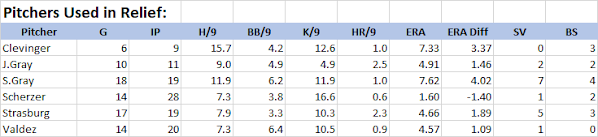
Here are the end results of our experiment:


Six starting pitchers posted a 3.29 ERA in 146 games as starters. The SAME SIX PITCHERS posted a 4.60 ERA pitching in relief. They allowed a lot more hits and walks in relief, but roughly the same rate of home runs and strikeouts. In total, they blew 14 saves in 32 opportunities, while saving only 16 games. Each one of those six starters posted an ERA at least one full run worse in relief than they did as starters, with the exception of Scherzer. Sonny Gray's ERA was FOUR RUNS higher in relief. Clevinger's was over three runs higher.

Needless to say, this experiment was a collosal failure. But should it have been? Diamond Mind's documentation mentions nothing about the effectiveness of a starting pitcher used in relief. The only mention is this: "A player who was not used as a reliever in real life does not have a relief rating. If he is used in relief, he will have above-average durability in that role, since his arm is accustomed to long outings."

There is no mention anywhere in the Diamond Mind documentation or website about a starting pitcher's performance suffering from pitching in relief...and yet here we are. Either the game DOES, in fact, punish pitchers used in relief who have no relief durability rating OR we simply ran into some amazingly bad luck.

How bad was our luck this year? Here are a few examples:

  • In a game against Highland, I brought Strasburg in to close out a 1-0 game in the ninth inning. He gave up a walk, and then two quick outs, before pinch hitter David Fletcher singled home the tying run.
  • In a game against Ravenswood, we were leading 2-0 heading into the bottom of the eighth. We tried to let Bednar close it out, but he allowed three singles to the first three batters he faced. So I handed the ball once again to Strasburg to stop the bleeding. Instead, he gave up a two-run triple to pinch hitter Jose Peraza.
  • We were on the verge of a come-from-behind win against our division rivals, Joplin, during the final chapter. We led by a score of 6-5 in the ninth. I handed the ball to Strasburg to close it out. Instead, he gave up back-to-back home runs to the only two batters he faced: the tying and walk-off-win runs of the game.
  • In a Chapter Three game against Allentown, both Strasburg AND Scherzer blew the game in relief. We led 6-2 heading into the eighth inning when Sean Doolittle ran into trouble. To stop the bleeding, we turned to Scherzer, who served up a two-run double and an RBI single to tie the score. Then, in the 12th inning, Strasburg served up a three-run home run to Matt Olson with two outs. Game over.
  • Sonny Gray was given a chance to save a game in Chapter One, in which we were leading 3-0 against South Loop. Once again, our bullpen (Aaron Bummer this time) ran into trouble, and once again, we asked one of our all-star starters to put out the fire. Instead, Gray coughed up a pair of singles and a sac fly to the #7 and #8 hitters in the Furies lineup. Bednar then served up a walk-off homer in extra innings.
  • Gray was also asked to protect a 6-5 lead in the ninth inning of a game against Vegas. He struck out the first two batters he faced...and then allowed two singles and a walk-off double.
  • We had used up most of our bullpen, including seldom-used Sam Tuivailala, by the time we brought Sonny Gray into the game to protect a 5-3 lead in the ninth inning. Instead, he served up a three-run triple (with two outs, of course) to pinch hitter Franklin Barreto.
  • Jon Gray was asked to pitch a very crucial eighth inning against Joplin in Chapter Five. Tasked with protecting a 5-4 lead, Gray instead gave up a three-run bomb to Marcell Ozuna.
  • We held a commanding 4-0 lead heading into the fifth inning against Los Altos when our bullpen slowly and methodically began to give it all away. The Undertakers managed to cut our lead to 6-5 heading into the eighth inning. Having once again exhausted our bullpen (Ohtani, Doolittle, Workman, and Bummer), we once again asked Jon Gray to get through the heart of the Los Altos lineup and get us out of the jam created by Workman and Bummer: no outs, two runners on. A walk, a single, a sac fly, and a three-run homer later, we were looking at yet another blown save and a crucial loss.
There are several more examples, of course, but this hopefully gets the point across. Time and again, throughout this entire season, we seemed to encounter unusually bad luck in late innings, regardless of who we used in those situations. Taken individually, each one of the above examples is perfectly reasonable. Shit happens, as they say. But when shit like this happens fourteen times (at least!) in one season, you have to wonder if the game is broken or if your assumptions about the game are simply wrong.

I tried to think outside the box. I tried to find a way to work around this dreaded projection disk and the smoothed-out stats that made dominant relief pitchers extinct. I tried to use our best assets in the best possible way. In the end, I failed. Plain and simple.

Monday, October 18, 2021

2021 Autopsy Report

A few random thoughts about the biggest bullshit season we've ever played.

  •  We outscored our opponents by 111 runs. Only three other teams in the BDBL accomplished that feat. All three are in the playoffs. The team with the best record in the Ozzie League, Las Vegas, outscored their opponents by only 74 runs (as of press time.) Joplin, with eight games remaining, has outscored their opponents by only 56.
  • Our theme all season was "We Can't Hit Worth Shit." In the end, we finished with a team batting line of .244/.309/.418. All three of those categories are below the league average.
  • On the plus side, Rafael Devers finally came around in the second half after an abysmal first half. He finished at .264/.323/.497 with 32 homers, which is close enough to his .292/.344/.530 (33 HR) disk line.
  • Devers finished with 29 errors and a .919 fielding percentage. As a team, we made 124 errors, which is two more than the next-highest total in the BDBL. Our .979 fielding percentage ranks dead-last in the BDBL.
  • Our pitching staff posted a 2.44 ERA in Chapter One, and a 3.87 ERA the rest of the way. It turned out that the weird anomaly wasn't our second chapter struggles, but the first chapter over-performance.
  • Max Scherzer (14-10, 2.79 ERA in 190 IP, 268 K) and Stephen Strasburg (15-12, 2.96 ERA in 201 IP, 280 K) both deserve consideration for the Cy Young award. Has there ever been a franchise in BDBL history with two pitchers earning Cy Young votes on a team that didn't make the postseason? I'm too lazy to look it up, but I'd be shocked if that has ever happened before.
  • We had trouble beating some horrible teams this year. We went just 8-8 against Darien, 9-7 against North Carolina, 6-6 against Ravenswood, and 6-6 against Lake Norman. That's just one game over .500 against the four worst teams (by record) in the Ozzie League.
  • We also couldn't beat good teams. We went 7-9 against our division rivals in Joplin, 4-8 against Allentown, and 4-8 against Los Altos. The only first-place team we managed to beat were the Vegas Flamingos (8-4).
  • We were a sub-.500 team on the road. If you could blame our offensive performance (or lack thereof) on our pitcher-friendly ballpark factors, then what explains this?
  • We blew -- get this -- FOURTEEN leads after the seventh inning. This was the highest total in the league (one more than Allentown.) We also blew nine games when tied after seven. And we went an abysmal 22-27 in one-run games.
  • Given the above, you would assume that our bullpen was atrocious. Yet, Sean Doolittle (1.64 ERA in 38+ IP), Brandon Workman (1.91 in 42+), and Alex Colome (2.52 in 64+) were all solid. Ten different pitchers blew saves for us this year, but our 25 total blown saves ranks just fourth. The first-place Miners blew 26 saves -- so far.
Put it all together. We outscored our opponents by a massive number of runs. We hit a little below league-average. We had two Cy Young-worthy starting pitchers, and a bullpen with several decent arms. So...how the hell did we suck so badly?

The best explanation I have is: bad luck and bad timing. We played extremely poorly in clutch situations all year -- as borne out by the numbers I shared last chapter. When we needed hits, we didn't get them. When we needed to prevent hits, we didn't.

I may never understand exactly what went wrong this season. All I know is that I'm glad it's over.

Monday, October 4, 2021

Looking Ahead to 2022

With the passing of each and every series this season, it seems more and more likely that 2021 will be a lost season for the Cowtippers. We simply can't sustain a winning streak of more than two games no matter who we face. Our most recent series, resulting in a split against the last-place team in our division -- at home, against their MP, no less -- is only the latest example.

At some point, I will perform one final autopsy on this 2021 team. Today, now that the 2021 MLB season is officially in the books, we can safely look ahead to 2022. To be certain, we have a lot of holes to fill and questions to answer, but equally-certain is that we should (emphasis on "should", given what we have experienced this year) have a very strong team next season.

Our 2022 lineup includes four of the top twenty hitters in the game (ranked by WAR), including Trea Turner (#1), Brandon Crawford (#13), Shohei Ohtani (#18), and Rafael Devers (#20). We also technically still own the #11 overall hitter in baseball, Jose Altuve, but...well, we're not allowed to say.

On the pitching side of the ball, we own the fifth-best pitcher in baseball, Max Scherzer, and...well, that's pretty much it. We do, however, have a very strong bullpen to make up for our fairly weak (and usage-limited) starting rotation beyond Scherzer.

At this moment, our starting lineup against left-handers looks like this:

1. Ramon Laureano, RF: .304/.380/.478
2. Trea Turner, 2B: .392/.437/.712
3. Andrew Benintendi, CF: .303/.340/.455
4. Shohei Ohtani, LF: .263/.344/.636
5. Rafael Devers, 3B: .278/.345/.405
6. TBD, 1B
7. TBD, C
8. Brandon Crawford, SS: .244/.300/.422

We also have a monster weapon against lefties off the bench in last chapter's pickup, Lane Thomas, who hit .381/.500/.603 in 78 PA's. Yadiel Hernandez (.300/.349/.513) gives us another pinch-hitting weapon.

Against righties:

1. Trea Turner, 2B: .305/.353/.475
2. Brandon Crawford, SS: .319/.401/.560
3. Rafael Devers, 3B: .280/.357/.621
4. Shohei Ohtani, LF: .254/.388/.566
5. Andrew Benintendi, CF: .264/.318/.437
6. TBD, 1B
7. TBD, RF
8. TBD, C

As you can see, we have several holes to fill from now until Opening Day. At this moment, we have roughly $20 million to fill those holes.

Our 2022 starting rotation, to date:

1. Max Scherzer: 179 IP, 597/541 splits
2. Framber Valdez: 135 IP, 717/626
3. Shohei Ohtani: 130 IP, 733/536
4. Jon Gray: 149 IP, 730/753

We need roughly 360 more innings, which means we'll need to acquire two starters before the bell rings.

Our bullpen currently looks like this:

RH Ryan Tepera: 61 IP, 429/559 splits
LH Jake McGee: 60 IP, 496/593
RH David Bednar: 61 IP, 531/611
RH Dominic Leone: 54 IP, 501/580
RH Paul Sewald: 65 IP, 650/545
LH Gregory Soto: 64 IP, 495/696
RH Matt Wisler: 49 IP, 702/653
RH Luis Garcia: 33 IP, 864/367
RH J.B. Wendelken: 44 IP, 803/644

This gives us three right-handed closers that are effective against both lefties and righties, two lefty-killing setup men, a righty-killer setup man, and a few innings-eaters. I would feel comfortable heading into Opening Day right now with this bullpen.

Overall, I feel that we are in a better position this year than we were at this time last year. Clearly, trying to win with a roster filled with all-star-caliber starting pitchers doesn't work in the BDBL. Maybe this offense-heavy approach will work better. It will certainly be a lot more fun watching the Cowtippers actually score some runs every now and then.

Thursday, September 9, 2021

Chapter Five Review

Another chapter, another crushing disappointment.

We finished Chapter Five the same way we finished the preceding three chapters, combined: with a .500 record. The epitome of mediocrity. We are now 52-52 since the end of Chapter One, despite adding Jose Altuve, Mike Clevinger, Kurt Suzuki, Kolten Wong, Sean Doolittle, and Brandon Workman during that period. Over that same period, we rank seventh in the Ozzie League in runs per game with a paltry 4.8 (barely above the league average of 4.6). We hit .240/.310/.421 over that timeframe, compared to a league-average rate of .247/.315/.419.

By nearly every measure, we own a league-average offense despite having five players on our roster that posted an 800+ OPS on the disk. All five of those players are underperforming, with an OPS that ranges anywhere from 29 (Christian Walker) to 105 (Rafael Devers) points below their disk OPS. We also have two other batters with a disk OPS of .790+. One of them (Ramon Laureano) is actually outperforming his disk OPS by 26 points. The other, David Freese, is currently sporting an OPS (as a Cowtipper) of .605 -- a whopping 186 points below his disk OPS.

After slumping for several chapters, Devers has finally picked up the pace of late, and yet he is still batting just .198/.260/.397 against lefties (compared to .288/.337/.506 on the disk.) Yadiel Hernandez -- sporting an OPS of 801 on the disk against right-handers -- is currently hitting .231/.310/.394 against righties. Kurt Suzuki and Kolten Wong, added in order to boost our offense, are hitting .244/.312/.402 and .230/.335/.323 for us, respectively.

On the pitching side, we posted an incredible team ERA of 2.44 in the first chapter. Our team ERA since then? 3.98. That is only the third-best ERA in the Ozzie League during that period. Same pitchers, with the exceptions of some quality additions, and yet they're over a run and a half WORSE. Go figure.

Sonny Gray became the first Cowtipper in history to toss a no-hitter earlier this year. He is sporting a 5.10 ERA over the past four chapters. Jon Gray was an all-star this year. His ERA since the end of Chapter One: 4.43. Mike Clevinger was the ace of the Akron staff before we acquired him. With Salem, he's just 4-3 with a 4.31 ERA over 62+ innings. Max Scherzer, Chapter One's Pitcher of the Chapter, is just 9-7 with a 3.60 ERA since then.

Stephen Strasburg, Scherzer, Clevinger, Sonny Gray, and Jon Gray, on paper, may be the greatest starting rotation ever assembled in the BDBL. Combined, they are just 37-34 with a 4.13 ERA over the past four chapters.

Lastly, there is the defense. We rank dead-last in the entire BDBL in fielding percentage (.979), and own a comfortable lead in errors. In fact, as of this writing, we're the only team in the BDBL with over 100 errors -- with 28 games left to play this season. Shohei Ohtani is a tremendous liability in the field no matter where we play him. He posted a .951 fielding percentage at first base (14 errors in 48 games started.) We then moved him to right field this past chapter, where he has already committed more errors (5) in 24 starts than any other outfielder on our roster has committed all season. In addition to the errors, Ohtani has atrocious range, takes bad routes to balls, and costs us several hits and runs just by being so godawful with the glove. Yet, because he owns the second-highest OPS on our team against right-handers, it's difficult not to include him in the lineup.

And then there is Alex Colome. In 55 innings, poor Alex has yet to record a put-out. He has only one assist. Yet, somehow, some way, in five total chances in the field, he has committed FOUR errors. Seriously. You can look it up.

Overall, the Cowtippers own the best runs differential in the McGowan Division -- and second-highest in the Ozzie League -- and yet we trail the Joplin Miners by two games. Our Pythagorean Difference of minus-6 is currently the worst in the Ozzie League, thanks in large part to our 19-24 record in one-run games. We lead the entire BDBL in blown leads after seven innings, with thirteen. No other team has more than ten. Yet, oddly enough, our bullpen ranks among the top five teams in the BDBL in lowest inherited runners scoring percentage, and in the middle of the pack in blown saves and blown save percentage. We simply have run into bad luck. Again and again and again and again.

As always, we discovered some incredibly aggravating new ways to lose baseball games in Chapter Five:

  • In our first of three losses against the Joplin Miners, Dan Vogelbach -- who had just been picked up off of the free agent garbage dump -- hit a home run off of Stephen Strasburg to take the lead. That ended up being the winning run of the game, as Joplin won by a score of 3-2.
  • In the third game of that series, we took a 4-2 lead in the first inning, and cruised into the seventh inning, up 5-2. The wheels then fell off the bus when #7 and #8 hitters Danny Santana and pinch hitter Justin Smoak hit an RBI triple and double, respectively. Taylor Guilbeau and Jon Gray then loaded the bases in the eighth inning, and wife-beater Marcell Ozuna followed with a grand slam home run, putting the game away.
  • Facing the lowly Darien Blue Wave, someone named Houser somehow managed to hold our offense to just one run over seven innings. The Darien bullpen then tossed two near-perfect innings of relief to close out the 3-1 win.
  • One of our many one-run losses came at the hands of the lowly Iron Spider Pigs, who managed to SHUT OUT our offense with the combined effort of Merrill Kelly and some guys named Irvin, Fairbanks, Brogdon, and Suarez. We racked up eight hits and five walks, and failed to score a single run. We left a whopping ELEVEN runners on base.
  • Against Bear Country, we carried a slim 7-6 lead into the eighth inning...and proceeded to serve up SIX runs. Clevinger, pitching in emergency relief, somehow managed to allow four runs to score on five hits and a walk...all while recording just one single out.
  • We lost a game against Los Altos when Sean Doolittle -- our most reliable relief pitcher and best pitcher against lefties -- allowed a walk-off seeing-eye squibbler up the middle to lefty Joc Pederson.
  • We carried a 4-0 lead into the fifth inning of the fourth game of that series, only to watch our pitching staff implode yet again in the late innings. We clung to a 6-5 lead heading into the eighth...and then watched in helplessness as FIVE runs crossed the plate.
Not only aren't we hitting or pitching well overall, but we're doing incredibly poorly in clutch situations. In late innings (7-9), when the score is within two runs or fewer, only five teams in the entire BDBL own a lower OPS than our .683 in that situation. When the score is tied in those late innings, our OPS drops to .608. When we're down by one run, our OPS in late innings is...get this...509! That is the same OPS as the South Philly Gritty!

We own a .727 OPS overall. With runners in scoring position, our OPS drops to .722. With two outs and RISP, it's .715.

Now, let's do pitching. Our overall team OPS allowed is .682. In innings 7-9, that OPS rises to .690. If the score is within two runs, our OPS is .689. Within one run: .698. With the score tied, it's just .525 -- best in the BDBL! But...if we're ahead in the late innings, watch out! If we lead by one, our OPS allowed jumps to a whopping .818! That's the fifth-worst in the league! If we're ahead by two, it's .723. With runners in scoring position, we allow a .729 OPS.

I don't know what to do about any of this. It is what it is. Improving this team via trade is no longer an option. Even if it were, the trades I've made to date have not improved this team whatsoever. We have 28 games to make up a two-game deficit. If we do, I do not feel confident at all about this team's chances in the postseason. If we don't, it's the most ridiculous thing that I've ever experienced in 22 seasons of playing in the BDBL.