Wednesday, October 20, 2021

Is It All My Fault?!

A recent post by four-time league champion and four-time OL Manager of the Year Jeff Paulson on our league forum lays the blame for our disappointing 2021 season squarely at my feet. The issue, Paulson believes, is that I used my starting pitchers in relief to the detriment of our team. It isn't the first time this strategy has been called into question. Paulson makes several valid points in his post. Was this strategy really to blame for Salem's mysterious under-performance this year? Let's take a look.

First, let me explain the reasoning behind this strategy. When I looked at our roster during the preseason, and compared it to every other roster in the league, it became glaringly obvious that we held an advantage over the rest of the league due to our starting rotation. I wanted to find a way to maximize that advantage as much as possible. Using those pitchers in the most high-leveraged situations seemed like a good strategy, especially given the weakness of our bullpen -- and the dearth of quality relief pitching anywhere in the league. Using one of our aces in an 8-0 game is a waste of resources. Using an ace to protect a one-run lead seemed to be a better use of their limited usage.

On Opening Day, Strasburg (.630 opponents OPS), Scherzer (.625), Sonny Gray (.671), and Jon Gray (.720 in Coors Field) all sported an opponents OPS lower than every reliever on our roster aside from David Bednar (.659) and Taylor Guilbeau (.666). Bednar (6.57 ERA) was pounded so hard in Chapter One that we removed him as closer. We used Scherzer twice out of the bullpen that chapter, and Sonny Gray five times, resulting in three saves for Gray out of four opportunities. The strategy, it seemed, was working.

The wheels fell completely off the wagon from that point forward, both in terms of our strategy and our season. As the season progressed, I stubbornly stuck to my original strategy, even after adding several quality relievers in trade. The fact is that our starting pitchers were still better than our relievers -- even the new guys.

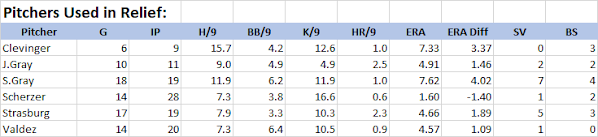
Here are the end results of our experiment:


Six starting pitchers posted a 3.29 ERA in 146 games as starters. The SAME SIX PITCHERS posted a 4.60 ERA pitching in relief. They allowed a lot more hits and walks in relief, but roughly the same rate of home runs and strikeouts. In total, they blew 14 saves in 32 opportunities, while saving only 16 games. Each one of those six starters posted an ERA at least one full run worse in relief than they did as starters, with the exception of Scherzer. Sonny Gray's ERA was FOUR RUNS higher in relief. Clevinger's was over three runs higher.

Needless to say, this experiment was a collosal failure. But should it have been? Diamond Mind's documentation mentions nothing about the effectiveness of a starting pitcher used in relief. The only mention is this: "A player who was not used as a reliever in real life does not have a relief rating. If he is used in relief, he will have above-average durability in that role, since his arm is accustomed to long outings."

There is no mention anywhere in the Diamond Mind documentation or website about a starting pitcher's performance suffering from pitching in relief...and yet here we are. Either the game DOES, in fact, punish pitchers used in relief who have no relief durability rating OR we simply ran into some amazingly bad luck.

How bad was our luck this year? Here are a few examples:

  • In a game against Highland, I brought Strasburg in to close out a 1-0 game in the ninth inning. He gave up a walk, and then two quick outs, before pinch hitter David Fletcher singled home the tying run.
  • In a game against Ravenswood, we were leading 2-0 heading into the bottom of the eighth. We tried to let Bednar close it out, but he allowed three singles to the first three batters he faced. So I handed the ball once again to Strasburg to stop the bleeding. Instead, he gave up a two-run triple to pinch hitter Jose Peraza.
  • We were on the verge of a come-from-behind win against our division rivals, Joplin, during the final chapter. We led by a score of 6-5 in the ninth. I handed the ball to Strasburg to close it out. Instead, he gave up back-to-back home runs to the only two batters he faced: the tying and walk-off-win runs of the game.
  • In a Chapter Three game against Allentown, both Strasburg AND Scherzer blew the game in relief. We led 6-2 heading into the eighth inning when Sean Doolittle ran into trouble. To stop the bleeding, we turned to Scherzer, who served up a two-run double and an RBI single to tie the score. Then, in the 12th inning, Strasburg served up a three-run home run to Matt Olson with two outs. Game over.
  • Sonny Gray was given a chance to save a game in Chapter One, in which we were leading 3-0 against South Loop. Once again, our bullpen (Aaron Bummer this time) ran into trouble, and once again, we asked one of our all-star starters to put out the fire. Instead, Gray coughed up a pair of singles and a sac fly to the #7 and #8 hitters in the Furies lineup. Bednar then served up a walk-off homer in extra innings.
  • Gray was also asked to protect a 6-5 lead in the ninth inning of a game against Vegas. He struck out the first two batters he faced...and then allowed two singles and a walk-off double.
  • We had used up most of our bullpen, including seldom-used Sam Tuivailala, by the time we brought Sonny Gray into the game to protect a 5-3 lead in the ninth inning. Instead, he served up a three-run triple (with two outs, of course) to pinch hitter Franklin Barreto.
  • Jon Gray was asked to pitch a very crucial eighth inning against Joplin in Chapter Five. Tasked with protecting a 5-4 lead, Gray instead gave up a three-run bomb to Marcell Ozuna.
  • We held a commanding 4-0 lead heading into the fifth inning against Los Altos when our bullpen slowly and methodically began to give it all away. The Undertakers managed to cut our lead to 6-5 heading into the eighth inning. Having once again exhausted our bullpen (Ohtani, Doolittle, Workman, and Bummer), we once again asked Jon Gray to get through the heart of the Los Altos lineup and get us out of the jam created by Workman and Bummer: no outs, two runners on. A walk, a single, a sac fly, and a three-run homer later, we were looking at yet another blown save and a crucial loss.
There are several more examples, of course, but this hopefully gets the point across. Time and again, throughout this entire season, we seemed to encounter unusually bad luck in late innings, regardless of who we used in those situations. Taken individually, each one of the above examples is perfectly reasonable. Shit happens, as they say. But when shit like this happens fourteen times (at least!) in one season, you have to wonder if the game is broken or if your assumptions about the game are simply wrong.

I tried to think outside the box. I tried to find a way to work around this dreaded projection disk and the smoothed-out stats that made dominant relief pitchers extinct. I tried to use our best assets in the best possible way. In the end, I failed. Plain and simple.

Monday, October 18, 2021

2021 Autopsy Report

A few random thoughts about the biggest bullshit season we've ever played.

  •  We outscored our opponents by 111 runs. Only three other teams in the BDBL accomplished that feat. All three are in the playoffs. The team with the best record in the Ozzie League, Las Vegas, outscored their opponents by only 74 runs (as of press time.) Joplin, with eight games remaining, has outscored their opponents by only 56.
  • Our theme all season was "We Can't Hit Worth Shit." In the end, we finished with a team batting line of .244/.309/.418. All three of those categories are below the league average.
  • On the plus side, Rafael Devers finally came around in the second half after an abysmal first half. He finished at .264/.323/.497 with 32 homers, which is close enough to his .292/.344/.530 (33 HR) disk line.
  • Devers finished with 29 errors and a .919 fielding percentage. As a team, we made 124 errors, which is two more than the next-highest total in the BDBL. Our .979 fielding percentage ranks dead-last in the BDBL.
  • Our pitching staff posted a 2.44 ERA in Chapter One, and a 3.87 ERA the rest of the way. It turned out that the weird anomaly wasn't our second chapter struggles, but the first chapter over-performance.
  • Max Scherzer (14-10, 2.79 ERA in 190 IP, 268 K) and Stephen Strasburg (15-12, 2.96 ERA in 201 IP, 280 K) both deserve consideration for the Cy Young award. Has there ever been a franchise in BDBL history with two pitchers earning Cy Young votes on a team that didn't make the postseason? I'm too lazy to look it up, but I'd be shocked if that has ever happened before.
  • We had trouble beating some horrible teams this year. We went just 8-8 against Darien, 9-7 against North Carolina, 6-6 against Ravenswood, and 6-6 against Lake Norman. That's just one game over .500 against the four worst teams (by record) in the Ozzie League.
  • We also couldn't beat good teams. We went 7-9 against our division rivals in Joplin, 4-8 against Allentown, and 4-8 against Los Altos. The only first-place team we managed to beat were the Vegas Flamingos (8-4).
  • We were a sub-.500 team on the road. If you could blame our offensive performance (or lack thereof) on our pitcher-friendly ballpark factors, then what explains this?
  • We blew -- get this -- FOURTEEN leads after the seventh inning. This was the highest total in the league (one more than Allentown.) We also blew nine games when tied after seven. And we went an abysmal 22-27 in one-run games.
  • Given the above, you would assume that our bullpen was atrocious. Yet, Sean Doolittle (1.64 ERA in 38+ IP), Brandon Workman (1.91 in 42+), and Alex Colome (2.52 in 64+) were all solid. Ten different pitchers blew saves for us this year, but our 25 total blown saves ranks just fourth. The first-place Miners blew 26 saves -- so far.
Put it all together. We outscored our opponents by a massive number of runs. We hit a little below league-average. We had two Cy Young-worthy starting pitchers, and a bullpen with several decent arms. So...how the hell did we suck so badly?

The best explanation I have is: bad luck and bad timing. We played extremely poorly in clutch situations all year -- as borne out by the numbers I shared last chapter. When we needed hits, we didn't get them. When we needed to prevent hits, we didn't.

I may never understand exactly what went wrong this season. All I know is that I'm glad it's over.

Monday, October 4, 2021

Looking Ahead to 2022

With the passing of each and every series this season, it seems more and more likely that 2021 will be a lost season for the Cowtippers. We simply can't sustain a winning streak of more than two games no matter who we face. Our most recent series, resulting in a split against the last-place team in our division -- at home, against their MP, no less -- is only the latest example.

At some point, I will perform one final autopsy on this 2021 team. Today, now that the 2021 MLB season is officially in the books, we can safely look ahead to 2022. To be certain, we have a lot of holes to fill and questions to answer, but equally-certain is that we should (emphasis on "should", given what we have experienced this year) have a very strong team next season.

Our 2022 lineup includes four of the top twenty hitters in the game (ranked by WAR), including Trea Turner (#1), Brandon Crawford (#13), Shohei Ohtani (#18), and Rafael Devers (#20). We also technically still own the #11 overall hitter in baseball, Jose Altuve, but...well, we're not allowed to say.

On the pitching side of the ball, we own the fifth-best pitcher in baseball, Max Scherzer, and...well, that's pretty much it. We do, however, have a very strong bullpen to make up for our fairly weak (and usage-limited) starting rotation beyond Scherzer.

At this moment, our starting lineup against left-handers looks like this:

1. Ramon Laureano, RF: .304/.380/.478
2. Trea Turner, 2B: .392/.437/.712
3. Andrew Benintendi, CF: .303/.340/.455
4. Shohei Ohtani, LF: .263/.344/.636
5. Rafael Devers, 3B: .278/.345/.405
6. TBD, 1B
7. TBD, C
8. Brandon Crawford, SS: .244/.300/.422

We also have a monster weapon against lefties off the bench in last chapter's pickup, Lane Thomas, who hit .381/.500/.603 in 78 PA's. Yadiel Hernandez (.300/.349/.513) gives us another pinch-hitting weapon.

Against righties:

1. Trea Turner, 2B: .305/.353/.475
2. Brandon Crawford, SS: .319/.401/.560
3. Rafael Devers, 3B: .280/.357/.621
4. Shohei Ohtani, LF: .254/.388/.566
5. Andrew Benintendi, CF: .264/.318/.437
6. TBD, 1B
7. TBD, RF
8. TBD, C

As you can see, we have several holes to fill from now until Opening Day. At this moment, we have roughly $20 million to fill those holes.

Our 2022 starting rotation, to date:

1. Max Scherzer: 179 IP, 597/541 splits
2. Framber Valdez: 135 IP, 717/626
3. Shohei Ohtani: 130 IP, 733/536
4. Jon Gray: 149 IP, 730/753

We need roughly 360 more innings, which means we'll need to acquire two starters before the bell rings.

Our bullpen currently looks like this:

RH Ryan Tepera: 61 IP, 429/559 splits
LH Jake McGee: 60 IP, 496/593
RH David Bednar: 61 IP, 531/611
RH Dominic Leone: 54 IP, 501/580
RH Paul Sewald: 65 IP, 650/545
LH Gregory Soto: 64 IP, 495/696
RH Matt Wisler: 49 IP, 702/653
RH Luis Garcia: 33 IP, 864/367
RH J.B. Wendelken: 44 IP, 803/644

This gives us three right-handed closers that are effective against both lefties and righties, two lefty-killing setup men, a righty-killer setup man, and a few innings-eaters. I would feel comfortable heading into Opening Day right now with this bullpen.

Overall, I feel that we are in a better position this year than we were at this time last year. Clearly, trying to win with a roster filled with all-star-caliber starting pitchers doesn't work in the BDBL. Maybe this offense-heavy approach will work better. It will certainly be a lot more fun watching the Cowtippers actually score some runs every now and then.

Thursday, September 9, 2021

Chapter Five Review

Another chapter, another crushing disappointment.

We finished Chapter Five the same way we finished the preceding three chapters, combined: with a .500 record. The epitome of mediocrity. We are now 52-52 since the end of Chapter One, despite adding Jose Altuve, Mike Clevinger, Kurt Suzuki, Kolten Wong, Sean Doolittle, and Brandon Workman during that period. Over that same period, we rank seventh in the Ozzie League in runs per game with a paltry 4.8 (barely above the league average of 4.6). We hit .240/.310/.421 over that timeframe, compared to a league-average rate of .247/.315/.419.

By nearly every measure, we own a league-average offense despite having five players on our roster that posted an 800+ OPS on the disk. All five of those players are underperforming, with an OPS that ranges anywhere from 29 (Christian Walker) to 105 (Rafael Devers) points below their disk OPS. We also have two other batters with a disk OPS of .790+. One of them (Ramon Laureano) is actually outperforming his disk OPS by 26 points. The other, David Freese, is currently sporting an OPS (as a Cowtipper) of .605 -- a whopping 186 points below his disk OPS.

After slumping for several chapters, Devers has finally picked up the pace of late, and yet he is still batting just .198/.260/.397 against lefties (compared to .288/.337/.506 on the disk.) Yadiel Hernandez -- sporting an OPS of 801 on the disk against right-handers -- is currently hitting .231/.310/.394 against righties. Kurt Suzuki and Kolten Wong, added in order to boost our offense, are hitting .244/.312/.402 and .230/.335/.323 for us, respectively.

On the pitching side, we posted an incredible team ERA of 2.44 in the first chapter. Our team ERA since then? 3.98. That is only the third-best ERA in the Ozzie League during that period. Same pitchers, with the exceptions of some quality additions, and yet they're over a run and a half WORSE. Go figure.

Sonny Gray became the first Cowtipper in history to toss a no-hitter earlier this year. He is sporting a 5.10 ERA over the past four chapters. Jon Gray was an all-star this year. His ERA since the end of Chapter One: 4.43. Mike Clevinger was the ace of the Akron staff before we acquired him. With Salem, he's just 4-3 with a 4.31 ERA over 62+ innings. Max Scherzer, Chapter One's Pitcher of the Chapter, is just 9-7 with a 3.60 ERA since then.

Stephen Strasburg, Scherzer, Clevinger, Sonny Gray, and Jon Gray, on paper, may be the greatest starting rotation ever assembled in the BDBL. Combined, they are just 37-34 with a 4.13 ERA over the past four chapters.

Lastly, there is the defense. We rank dead-last in the entire BDBL in fielding percentage (.979), and own a comfortable lead in errors. In fact, as of this writing, we're the only team in the BDBL with over 100 errors -- with 28 games left to play this season. Shohei Ohtani is a tremendous liability in the field no matter where we play him. He posted a .951 fielding percentage at first base (14 errors in 48 games started.) We then moved him to right field this past chapter, where he has already committed more errors (5) in 24 starts than any other outfielder on our roster has committed all season. In addition to the errors, Ohtani has atrocious range, takes bad routes to balls, and costs us several hits and runs just by being so godawful with the glove. Yet, because he owns the second-highest OPS on our team against right-handers, it's difficult not to include him in the lineup.

And then there is Alex Colome. In 55 innings, poor Alex has yet to record a put-out. He has only one assist. Yet, somehow, some way, in five total chances in the field, he has committed FOUR errors. Seriously. You can look it up.

Overall, the Cowtippers own the best runs differential in the McGowan Division -- and second-highest in the Ozzie League -- and yet we trail the Joplin Miners by two games. Our Pythagorean Difference of minus-6 is currently the worst in the Ozzie League, thanks in large part to our 19-24 record in one-run games. We lead the entire BDBL in blown leads after seven innings, with thirteen. No other team has more than ten. Yet, oddly enough, our bullpen ranks among the top five teams in the BDBL in lowest inherited runners scoring percentage, and in the middle of the pack in blown saves and blown save percentage. We simply have run into bad luck. Again and again and again and again.

As always, we discovered some incredibly aggravating new ways to lose baseball games in Chapter Five:

  • In our first of three losses against the Joplin Miners, Dan Vogelbach -- who had just been picked up off of the free agent garbage dump -- hit a home run off of Stephen Strasburg to take the lead. That ended up being the winning run of the game, as Joplin won by a score of 3-2.
  • In the third game of that series, we took a 4-2 lead in the first inning, and cruised into the seventh inning, up 5-2. The wheels then fell off the bus when #7 and #8 hitters Danny Santana and pinch hitter Justin Smoak hit an RBI triple and double, respectively. Taylor Guilbeau and Jon Gray then loaded the bases in the eighth inning, and wife-beater Marcell Ozuna followed with a grand slam home run, putting the game away.
  • Facing the lowly Darien Blue Wave, someone named Houser somehow managed to hold our offense to just one run over seven innings. The Darien bullpen then tossed two near-perfect innings of relief to close out the 3-1 win.
  • One of our many one-run losses came at the hands of the lowly Iron Spider Pigs, who managed to SHUT OUT our offense with the combined effort of Merrill Kelly and some guys named Irvin, Fairbanks, Brogdon, and Suarez. We racked up eight hits and five walks, and failed to score a single run. We left a whopping ELEVEN runners on base.
  • Against Bear Country, we carried a slim 7-6 lead into the eighth inning...and proceeded to serve up SIX runs. Clevinger, pitching in emergency relief, somehow managed to allow four runs to score on five hits and a walk...all while recording just one single out.
  • We lost a game against Los Altos when Sean Doolittle -- our most reliable relief pitcher and best pitcher against lefties -- allowed a walk-off seeing-eye squibbler up the middle to lefty Joc Pederson.
  • We carried a 4-0 lead into the fifth inning of the fourth game of that series, only to watch our pitching staff implode yet again in the late innings. We clung to a 6-5 lead heading into the eighth...and then watched in helplessness as FIVE runs crossed the plate.
Not only aren't we hitting or pitching well overall, but we're doing incredibly poorly in clutch situations. In late innings (7-9), when the score is within two runs or fewer, only five teams in the entire BDBL own a lower OPS than our .683 in that situation. When the score is tied in those late innings, our OPS drops to .608. When we're down by one run, our OPS in late innings is...get this...509! That is the same OPS as the South Philly Gritty!

We own a .727 OPS overall. With runners in scoring position, our OPS drops to .722. With two outs and RISP, it's .715.

Now, let's do pitching. Our overall team OPS allowed is .682. In innings 7-9, that OPS rises to .690. If the score is within two runs, our OPS is .689. Within one run: .698. With the score tied, it's just .525 -- best in the BDBL! But...if we're ahead in the late innings, watch out! If we lead by one, our OPS allowed jumps to a whopping .818! That's the fifth-worst in the league! If we're ahead by two, it's .723. With runners in scoring position, we allow a .729 OPS.

I don't know what to do about any of this. It is what it is. Improving this team via trade is no longer an option. Even if it were, the trades I've made to date have not improved this team whatsoever. We have 28 games to make up a two-game deficit. If we do, I do not feel confident at all about this team's chances in the postseason. If we don't, it's the most ridiculous thing that I've ever experienced in 22 seasons of playing in the BDBL.

Thursday, August 5, 2021

It's Over

The division race is over. The 2021 season is over. It is time to concentrate on 2022. I am officially done with this team. For the first time (I think?) in our 22-year history, I am stepping down as the manager. I have handed off that duty to the MP. I have zero interest in managing this group of players any longer. It is pointless, and it is a waste of my time.

Our three-game deficit in the McGowan Division ballooned to five games thanks to a series loss -- at home -- against the Joplin Miners. Dan Vogelbach, who was discarded by the Los Altos Undertakers earlier this season and plucked off the free agent garbage dump by Doyle -- despite the fact that Doyle will have to pay $1.1 million at the end of this season to cut him -- hit two crucial home runs in the series, and was easily the MVP. (Note: although I say Doyle will have to pay to cut him, we all know Doyle won't be around at that point, so he won't pay any penalty whatsoever.)

The coup de grace was when noted wife-beater Marcell Ozuna -- discarded by the Highland Freedom earlier this year -- hit a game-winning pinch-hit grand slam home run in Game Three off of Jon Gray, who just happens to be one of the best pitchers in this game at preventing right-handed hitters like Ozuna from hitting home runs.

That was the straw that finally broke this camel's back.

Oh -- I also got to experience something I never thought was possible! Jim Doyle actually found a way to be even more of an annoying asshole than he already is! Throughout all three games that I managed, Doyle repeatedly took the first pitch, just to prolong the agony. And despite putting a number of his hitters into an early 0-1 count, they managed to reach base despite his effort to the contrary.

This game, and this ridiculous 2021 season, can kiss my ass.

Friday, July 30, 2021

Chapter Five Additions

I wasn't planning to make another trade this season, but when the opportunity arose to add Jose Altuve to our lineup, I just couldn't resist pulling the trigger. We have been hemorrhaging offensive production all season long at one particular spot in our lineup. Against left-handers, that spot has been Jose Pirela's. Pirela carries an 800+ OPS against lefties on the disk, but has hit just .217/.225/.380 this season. Against right-handers, Yadiel Hernandez sports an 800+ OPS on the disk, but has hit just .239/.320/.417.

Altuve doesn't play left field, so when the offer was made, I assumed he wasn't a fit. Then I realized that Kolten Wong and Nick Senzel can both shift to the outfield, which opens up second base. With one move, we've replaced an entirely useless dead spot in our lineup with an all-star-caliber hitter.

Of course, no acquisition comes without sacrifice. I've gone back and forth on Nick Madrigal's value to our franchise over the years. At times, I regarded him as a foundational player, and grouped him in with Devers, Turner, Ohtani, and Rutschman. At other times, I thought he could best serve as trade bait. After watching him play for roughly half a season in the big leagues, I have a pretty good idea what he is and what he will become.

Initially, my plan was to trade for a high pick in the upcoming free agent draft, use that pick to select David Fletcher, and it would be as if we added Altuve for nothing. (Fletcher and Madrigal are nearly identical players.) However, the idea of keeping Altuve is growing on me. Ohtani, Turner, and Devers all rank among the top ten (seven, really) in WAR this season. Altuve gives us four players in the top fifteen. Brandon Crawford makes five out of the top twenty. That's a very nice foundation for 2022.

The only issue with keeping Altuve is his $12 million salary. That would leave us with around $8 million to fill several holes. Also, keeping him means there would be nowhere to put Crawford. These are both good problems to have. Worst-case scenario is that we trade either Altuve or Max Scherzer and plug some of those holes in the process. We have already had an inquiry about Altuve, so I'm sure that it wouldn't be difficult at all to trade him or Scherzer.

*** 

Unfortunately, we were only able to pick up two free agents this chapter, due to a lack of players that we could release. That said, we're happy to have the two that we got: Sergio Romo and Dominic Leone. We've managed to collect a pretty decent bullpen for 2022 if they all continue pitching as well as they have to date:

David Bednar: 40 IP, 28 H, 5 HR, 15 BB, 50 K, 2.70 ERA, 612/626 splits

Dominic Leone: 23 IP, 14 H, 2 HR, 10 BB, 27 K, 1.54 ERA, 450/546 splits

Sergio Romo: 38 IP, 28 H, 2 HR, 11 BB, 39 K, 3.52 ERA, 591/554 splits

Jake McGee: 42 IP, 27 H, 5 HR, 7 BB, 45 K, 2.34 ERA, 376/591 splits

Paul Sewald: 31 IP, 19 H, 2 HR, 12 BB, 54 K, 2.30 ERA, 563/491 splits

Gregory Soto: 43 IP, 32 H, 4 HR, 27 BB, 53 K, 2.95 ERA, 526/697 splits

Jeffrey Springs: 43 IP, 33 H, 9 HR, 14 BB, 61 K, 3.53 ERA, 838/758 splits

Ryan Tepera: 43 IP, 22 H, 3 HR, 12 BB, 50 K, 2.91 ERA, 387/512 splits

Matt Wisler: 40 IP, 34 H, 6 HR, 9 BB, 53 K, 4.05 ERA, 658/713 splits

The best part about those nine guys above is that they earn a combined salary of just $1.3 million. Bednar was acquired as a free agent last year, and is the only one with a salary above $100K. All of the others were picked up this year, either in the $100K rounds of the draft or via free agency. 

*** 

Okay, let's talk about the 800-pound gorilla in the room. The unwritten rule in any fantasy baseball league is that each owner makes decisions in good faith, with his franchise's best interests (both present and future) at heart, just as a real-life GM of a real-life baseball team would do. Part of that good faith practice is the idea that no GM who plans to keep his job would ever burn his franchise to the ground in order to win now at any and all costs. It would be foolish and counterproductive to do so -- unless that GM doesn't plan to keep his job.

Jim Doyle is acting very much like someone who doesn't plan to stick around after this season. If that is true, and he has no future in the BDBL, then it doesn't matter what decisions he makes that impact his franchise's future. He can -- and has -- throw caution to the wind, sell the entire farm, and throw all of his eggs into the win-now basket, because hey, what does he have to lose? That is exactly what he's done by trading the last few pieces of his franchise's future in exchange for Cody Bellinger and Corey Knebel.

I was involved in trade talks for both players this chapter, but ultimately decided that it wasn't worth the cost to our future. Doyle doesn't have to worry about that, evidently. As I wrote here many times before, it doesn't matter what the Joplin Miners do or don't do. All that matters is how the Salem Cowtippers perform on the field. When you play .500 ball over three chapters, it doesn't matter what your competitors do. You aren't going to win the division, regardless. We simply need to win. It's as simple as that.

This game has a way of rewarding bad behavior. See Paul Marazita's three straight trophies to kick off this league, or John Duel's championship season before he bailed, or Anthony Peburn's string of division titles. Those infamous villains of BDBL past may soon be joined by another.

Thursday, July 15, 2021

Chapter Four Review

Welp.

At this point, four chapters into the 2021 season, it is safe to assume that the Cowtippers team that we all witnessed in Chapter One was an anomaly. That team, with its outstanding pitching, solid hitting, and passable defense, was a mirage. The real Cowtippers are the ones that we've seen in the three chapters since then. We played .643 baseball in Chapter One. We have played .500 ball since then. We are Team Mediocrity.

This pathetic team, with its starting rotation that includes four all-stars, and a lineup that includes Rafael Devers, Ramon Laureano, Trea Turner, Shohei Ohtani, and numerous other hitters with an 800+ OPS split, has been the very definition of mediocre since the end of Chapter One.

When you are four games behind in the standings, there are two things your team must do in order to gain ground in the race: 1) beat bad teams, and 2) capitalize on the opportunity when the first-place team stumbles. We did neither this chapter. We went 4-5 against the last-place Ravenswood Infidels and Lake Norman Monsters, and we finished with the same shitty 13-11 record as the hapless Joplin Miners.

To put things into perspective, the North Carolina Iron Spider Pigs, who own the fourth-worst record in the BDBL, SWEPT the Monsters in Chapter Four. We barely managed a split.

We lost one game to the Monsters because Dylan Bundy -- who came into the game with an ERA over 7.00 -- held us to just three runs in six innings, while our "all-star", Sonny Gray, was whacked around for five runs on ten hits in four innings. We lost another game to Lake Norman when Framber Valdez and Mike Clevinger, pitching in emergency relief, blew a 4-0 lead.

We lost three out of four games to Ravenswood, including two games where the Infidels started a pitcher with a 7.00+ ERA. Stephen Strasburg, the starting pitcher for the OL all-star team, blew a save in that series. Rafael Devers went 0-for-12. We managed to hit just .215 against a pitching staff that owns the 8th-best ERA in the Ozzie League.

We lost a game to Los Altos when Sonny Gray allowed TWELVE runs in five innings. We scored five runs against the Undertakers' starter...and lost. Looking back, it is impossible to believe that Sonny Gray actually tossed a perfect game this year. It's been all downhill for him since then.

We lost a game to the Akron Ryche when we called on Max Scherzer, all-star, to hold a 4-2 lead in the ninth inning. The very first batter of the inning hit a weak grounder back to the mound. Scherzer snagged it, jogged over to first, and underhanded it to the first baseman...who somehow dropped it. This led to a three-run inning. Another walk-off, one-run, loss. Scherzer failed to even record an out in that inning.

The Cowtippers pitching staff posted an ERA of 2.44 in Chapter One. Our ERA this past chapter was 4.11. Folks, this is the same pitching staff! The only changes to that staff since Chapter One were the additions of Mike Clevinger, Sean Doolittle, and Brandon Workman. We added three quality pitchers and our pitching staff somehow got WORSE!

Our offense has posted a below-average OPS (.722) this season. We currently rank #18 out of 24 teams in that category. The Myrtle Beach Hitmen have a higher team OPS than Salem. So do the Darien Blue Wave. Robinson Chirinos, David Freese, Nick Madrigal, Jose Pirela, and Rafael Devers all own an OPS that is 100+ points lower than the one on the projection disk.

On the plus side (there's a plus side??), Devers' bat finally -- FINALLY! -- heated up in Chapter Four. He managed to hit .338/.424/.525 for the chapter, with three homers in 80 at-bats. Of course, most of that came from the bottom of the lineup, so he managed to drive in only 11 runs. Still, his performance was perhaps the only highlight of the chapter.

So...what now? We only have two chapters remaining to gain four games in the standings. Hell, we've overcome an eight-game deficit in only one chapter in the past. The difference is that we had a decent team back then. This is not a decent team. It should be, but clearly, it isn't.